


How China became capitalist /
"How China Became Capitalist details the extraordinary, and often accidental, journey that China has taken over the past thirty years in transforming itself from a closed agrarian socialist economy to an indomitable force in the international arena. The authors revitalize the debate around the...
| Main Author: | Coase, R. H. |
|---|---|
| Other Authors: | Wang, Ning, 1971- |
| Format: | Book |
| Language: | English |
| Institution: | Perbadanan Perpustakaan Awam Negeri Perak |
| Library: | Main Library |
| Record Id / ISBN-0: | ppap.48624 / 9781137019363 (cloth) |
| Online Public Access Catalog: | Perbadanan Perpustakaan Awam Negeri Perak |
| Published: |
Houndmills, Basingstoke, Hampshire ; New York, NY :
Palgrave Macmillan,
2012.
|
| Subjects: | |
| Online Access: |
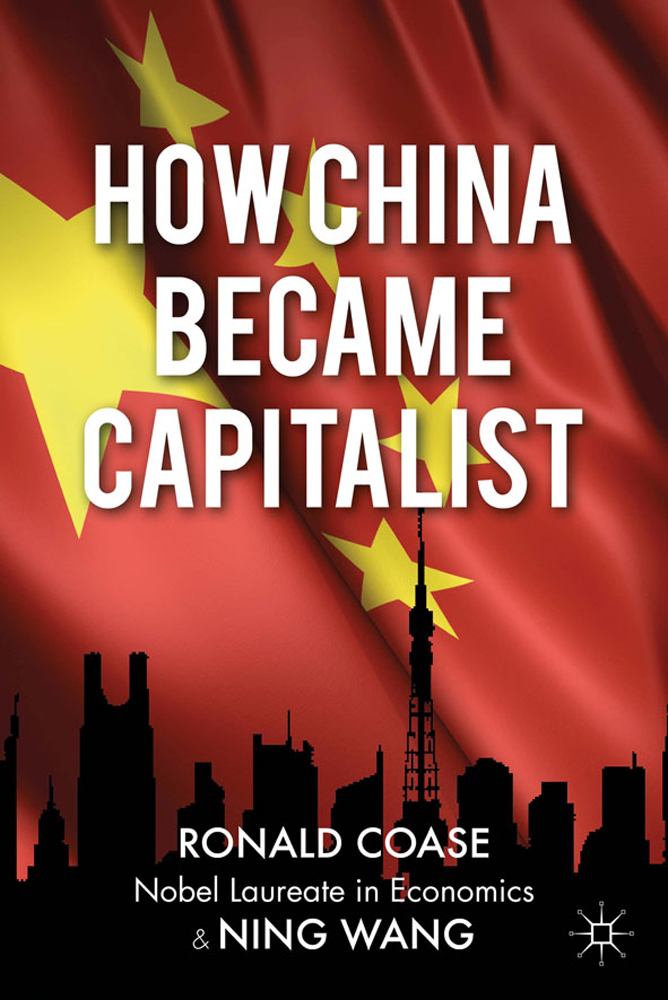
Cover image |
| Tags: |
Add Tag
No Tags, Be the first to tag this record!
|
| LEADER | 03060cam a2200421 i 4500 | ||
|---|---|---|---|
| 001 | 17268391 | ||
| 003 | PPANPk | ||
| 005 | 20141205090933.0 | ||
| 008 | 120423s2012 enkb b 001 0 eng | ||
| 010 | |a 2012016703 | ||
| 020 | |a 9781137019363 (cloth) | ||
| 040 | |a DLC |b eng |c DLC |e rda |d DLC | ||
| 082 | 0 | 0 | |a 330.12/20951 |2 23 |
| 100 | 1 | |a Coase, R. H. |q (Ronald Harry) | |
| 245 | 1 | 0 | |a How China became capitalist / |c Ronald Coase and Ning Wang. |
| 264 | 1 | |a Houndmills, Basingstoke, Hampshire ; |a New York, NY : |b Palgrave Macmillan, |c 2012. | |
| 300 | |a xi, 256 p. : |b maps ; |c 25 cm. | ||
| 336 | |a text |2 rdacontent | ||
| 337 | |a unmediated |2 rdamedia | ||
| 338 | |a volume |2 rdacarrier | ||
| 504 | |a Includes bibliographical references (pages 230-246) and index. | ||
| 505 | 8 | |a Machine generated contents note: Preface -- China at the Death of Mao -- China in Transition -- How China's Market Reform Began -- A Bird in the Cage: Market Reform Under Socialism -- Growing out of Socialism: Capitalism with Chinese Characteristics -- From Capitalism to Capitalisms. | |
| 520 | |a "How China Became Capitalist details the extraordinary, and often accidental, journey that China has taken over the past thirty years in transforming itself from a closed agrarian socialist economy to an indomitable force in the international arena. The authors revitalize the debate around the development of the Chinese system through the use of primary sources. They persuasively argue that the reforms implemented by the Chinese leaders did not represent a concerted attempt to create a capitalist economy, but that the ideas from the West eventually culminated in a fundamental change to their socialist model, forming an accidental path to capitalism. Coase and Wang argue that the pragmatic approach of "seeking truth from fact" is in fact much more in line with Chinese culture. How China Became Capitalist challenges the received wisdom about the future of the Chinese economy, arguing that while China has enormous potential for growth, this could be hampered by the leaders' propensity for control, both in terms of economics and their monopoly of ideas and power"-- |c Provided by publisher. | ||
| 650 | 0 | |a Mixed economy |z China. | |
| 650 | 0 | |a Capitalism |z China. | |
| 650 | 7 | |a BUSINESS & ECONOMICS / Economics / Theory. |2 bisacsh | |
| 650 | 7 | |a HISTORY / Asia / China. |2 bisacsh | |
| 650 | 7 | |a BUSINESS & ECONOMICS / Economic History. |2 bisacsh | |
| 650 | 7 | |a BUSINESS & ECONOMICS / International / Economics. |2 bisacsh | |
| 651 | 0 | |a China |x Economic policy |y 1976-2000. | |
| 651 | 0 | |a China |x Economic policy |y 2000- | |
| 651 | 0 | |a China |x Economic conditions |y 1976-2000. | |
| 651 | 0 | |a China |x Economic conditions |y 2000- | |
| 700 | 1 | |a Wang, Ning, |d 1971- | |
| 856 | 4 | 2 | |3 Cover image |u http://www.netread.com/jcusers2/bk1388/363/9781137019363/image/lgcover.9781137019363.jpg |
| 942 | |2 ddc |c BK | ||
| 999 | |c 48624 |d 48624 | ||
| 952 | |0 0 |1 0 |2 ddc |4 0 |6 R_330_122000000000000_COA |7 1 |8 REF |9 451230 |a HQ |b HQ |c REF |d 2014-12-05 |g 396.00 |o R 330.1220 COA |p 0009835773 |r 2014-12-05 |w 2014-12-05 |y BK |z R | ||